
Introduction
Search Engine Optimization (SEO) the Most Important SEO Ranking Factors is the process of improving a website so that it can appear more prominently in search engine results. When people search for information, products, or services on Google, search engines use many signals and systems to determine which pages are most useful and relevant to display.
These signals are commonly referred to as SEO ranking factors.
SEO ranking factors are the different characteristics and signals that search engines may consider when evaluating webpages. They can include content quality, relevance, links, website accessibility, page experience, technical health, and many other aspects.
It is important to understand that there is no single ranking factor that guarantees a top position on Google. Search engines use many systems together, and the importance of different signals can vary depending on the search query and context.
For this reason, successful SEO requires a balanced strategy rather than focusing on one specific factor.
In this article, we will explore the most important SEO ranking factors and explain how each one can contribute to better search visibility.
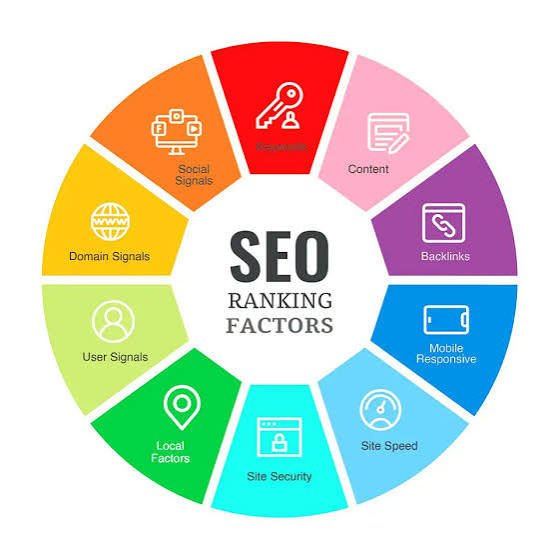
1. High-Quality and Helpful Content
One of the most important foundations of SEO is creating useful content.
Search engines aim to provide users with information that is relevant, reliable, and helpful. Therefore, websites should focus on creating content that genuinely satisfies the user’s needs rather than producing content only to manipulate rankings.
High-quality content should:
- Answer the user’s question
- Provide accurate information
- Be easy to understand
- Be well organized
- Add useful information
- Match the search intent
- Avoid unnecessary repetition
- Be written for people first
For example, if someone searches for “how to improve website SEO,” a useful article should provide practical explanations rather than simply repeating the phrase “website SEO” throughout the page.
Quality and usefulness are more important than simply creating long content.
2. Search Intent
Search intent is the reason behind a user’s search.
Understanding search intent is essential because users expect different types of results depending on what they are searching for.
For example:
“What is SEO?” has informational intent.
The user wants to learn something.
“Best SEO tools” may have commercial investigation intent.
The user is researching available options.
“Buy SEO software” has transactional intent.
The user is likely looking to purchase something.
If your content does not match the intent behind a search query, it may struggle to perform well even if it contains the target keyword.
Therefore, SEO professionals should analyze the search results and create the type of content users are actually looking for.
3. Relevant Keywords
Keywords are words and phrases that people use when searching for information.
Keyword research helps identify relevant search terms that can guide content creation and optimization.
For example, a digital marketing website may target keywords such as:
- Digital marketing services
- SEO services
- Technical SEO
- Keyword research
- Social media marketing
- Google Ads
Keywords should be used naturally in appropriate places such as titles, headings, URLs, and body content.
However, repeating keywords excessively is not a good SEO strategy. Keyword stuffing can make content unnatural and may violate search engine spam policies.
Modern SEO focuses on understanding the overall topic and satisfying the user’s needs rather than repeating an exact keyword many times.
4. Backlinks and Website Authority
A backlink is a link from another website to your website.
Backlinks can help search engines discover pages and can act as signals of authority or relevance when they come from reputable sources.
For example, if a respected industry website naturally references your research or article, that link may provide a useful signal about your site’s credibility.
However, not all backlinks are equally valuable.
Good link-building practices focus on earning links through:
- Useful content
- Original research
- Digital PR
- Industry resources
- Helpful guides
- Genuine relationships
Buying large numbers of low-quality links or participating in manipulative link schemes can create SEO risks.
The goal should be to earn relevant and trustworthy links rather than simply collecting as many links as possible.
5. Technical SEO
Technical SEO focuses on the technical aspects of a website that help search engines crawl, understand, and index its pages.
Important technical SEO areas include:
- Crawlability
- Indexability
- Website speed
- Mobile usability
- XML sitemaps
- Robots.txt
- Canonical URLs
- Redirects
- Structured data
- Website architecture
- HTTPS
A website can have excellent content, but technical problems may prevent search engines from accessing or understanding important pages.
Therefore, maintaining a technically healthy website is an important part of SEO.
6. Mobile-Friendly Design
A large amount of web traffic comes from mobile devices.
A mobile-friendly website should display properly on smartphones and tablets and should allow users to navigate and interact with the site easily.
Important elements include:
- Responsive design
- Readable text
- Properly sized buttons
- Easy navigation
- Fast loading
- Correctly displayed images
- No unnecessary horizontal scrolling
A website that provides a poor mobile experience can make it difficult for visitors to use the site.
Therefore, businesses should ensure that their websites work effectively across different devices.
7. Page Speed and Performance
Page speed is another important part of website performance and user experience.
Users generally prefer websites that load quickly. Slow pages can lead to frustration and may cause visitors to leave.
Website performance can be improved by:
- Compressing images
- Using modern image formats
- Reducing unnecessary JavaScript
- Optimizing CSS
- Improving server response time
- Using browser caching
- Removing unnecessary resources
Tools such as PageSpeed Insights and Lighthouse can help identify performance problems.
A fast website creates a smoother experience and provides a stronger technical foundation for SEO.
8. Core Web Vitals
Core Web Vitals are performance metrics used by Google to evaluate important aspects of webpage experience.
The current Core Web Vitals include:
Largest Contentful Paint (LCP)
LCP measures how quickly the main content of a page becomes visible.
Interaction to Next Paint (INP)
INP measures how responsive a webpage is to user interactions.
Cumulative Layout Shift (CLS)
CLS measures unexpected movement of content during page loading.
Improving these metrics can create a better experience for visitors.
However, website owners should not focus on Core Web Vitals at the expense of content quality and relevance. SEO success requires a combination of different factors.
9. Website Security
Website security is important for both users and search engines.
HTTPS encrypts information exchanged between a visitor and a website.
A secure website helps protect users and creates a more trustworthy browsing experience.
Websites should maintain valid security certificates and avoid security problems that could compromise visitors.
For businesses that collect personal information or process transactions, website security is particularly important.
10. Internal Linking
Internal links connect pages within the same website.
For example, an article about keyword research could naturally link to another article about on-page SEO.
Internal linking can help:
- Users discover related content
- Search engines discover pages
- Establish relationships between topics
- Distribute internal authority
- Improve website navigation
A well-planned internal linking structure can make a website easier to understand and navigate.
11. Website Structure and Architecture
Website architecture refers to how webpages are organized.
A clear website structure helps both users and search engines understand the relationships between different pages.
For example:
Homepage → Services → SEO Services → Technical SEO
This structure creates a logical hierarchy.
Important pages should generally be easy to reach through navigation and internal links.
A well-organized website can also make it easier for search engine crawlers to discover important content.
12. Title Tags and Meta Descriptions
The title tag tells search engines and users what a webpage is about.
For example:
Technical SEO: A Complete Beginner’s Guide
A good title should be:
- Clear
- Descriptive
- Relevant
- Useful to the user
Meta descriptions provide a short summary of a webpage. They are primarily useful for helping users understand what a search result is about.
While meta descriptions are not a direct Google ranking factor, a useful description can help users decide whether to click a result.
13. Image Optimization
Images can improve the quality and usefulness of website content, but poorly optimized images can negatively affect page performance.
Image optimization can include:
- Compressing images
- Using appropriate formats
- Providing descriptive filenames
- Adding useful alt text
- Serving appropriately sized images
- Avoiding unnecessarily large files
Alt text is particularly important for accessibility because it can describe an image to users who cannot see it.
Image optimization can therefore support both accessibility and website performance.
14. User Experience
User experience, often called UX, refers to how easily and comfortably visitors can use a website.
A good website should be:
- Easy to navigate
- Fast
- Mobile-friendly
- Accessible
- Clearly organized
- Easy to read
- Free from intrusive problems
For example, if a visitor lands on a page and immediately sees the information they need, the experience is likely to be better than on a page filled with confusing navigation and distracting elements.
SEO and UX often work together because both aim to help users find and consume useful information.
15. Freshness and Content Updates
Some searches require fresh information.
For example, searches about:
- Current events
- Software updates
- Product information
- Prices
- Technology
- Regulations
may require up-to-date content.
Updating old articles when information changes can help keep them accurate and useful.
However, simply changing the publication date without making meaningful improvements does not automatically make content better.
Content should be updated when there is genuinely new or corrected information to add.
16. E-E-A-T and Trustworthiness
Google’s quality guidance discusses E-E-A-T, which stands for:
- Experience
- Expertise
- Authoritativeness
- Trustworthiness
E-E-A-T is not a single ranking factor that can simply be “turned on.” Instead, it is a framework used in Google’s search quality guidance for thinking about the quality and credibility of content.
Websites can demonstrate credibility by:
- Providing accurate information
- Identifying authors where appropriate
- Showing relevant experience
- Citing trustworthy sources
- Providing clear business information
- Maintaining accurate content
- Being transparent with users
Trust is especially important for topics where inaccurate information could significantly affect people’s health, finances, or safety.
17. Local SEO Signals
For businesses serving a specific geographic area, local SEO can be extremely important.
Local SEO helps businesses become visible for searches such as:
“digital marketing agency near me”
or:
“SEO services in [location]”
Important local SEO activities include:
- Maintaining an accurate Google Business Profile
- Consistent business information
- Relevant local content
- Customer reviews
- Local citations
- Quality local links
- Clear contact information
Local search results can use different signals depending on the query and location.
18. Structured Data
Structured data provides search engines with additional information about webpage content.
It can be used for different types of content, including:
- Articles
- Products
- Events
- Organizations
- Local businesses
- Recipes
When implemented correctly and when eligible, structured data can help search engines understand content and may make pages eligible for certain enhanced search-result features.
However, structured data does not guarantee higher rankings or enhanced search appearances.
19. Content Depth and Topical Coverage
Good SEO content should cover a topic sufficiently to answer the user’s needs.
For example, an article about keyword research could discuss:
- What keyword research means
- Why it matters
- Keyword types
- Search intent
- Keyword difficulty
- Search volume
- Keyword research tools
- How to select keywords
- Common mistakes
The goal is not simply to make an article long. The goal is to provide the information users need.
A shorter article that directly answers a question can be more useful than a long article filled with unnecessary information.
20. Avoiding Spam and Manipulative SEO Techniques
Search engines have systems and policies designed to identify spam and manipulative practices.
Examples of risky practices include:
- Keyword stuffing
- Hidden text
- Manipulative link schemes
- Automatically generated low-value content
- Cloaking
- Doorway pages
- Misleading redirects
Businesses should focus on creating useful content and providing a positive experience instead of trying to manipulate search engines.
Sustainable SEO is based on long-term value.
How SEO Ranking Factors Work Together
SEO ranking the Most Important SEO Ranking Factors should not be considered separately.
For example, imagine a website with:
- Excellent content
- Strong backlinks
- Relevant keywords
but the website is extremely slow and important pages cannot be crawled.
Its SEO performance may still suffer.
Similarly, a technically perfect website with poor content may not satisfy users.
A strong SEO strategy combines:
Helpful Content + Search Intent + Technical SEO + User Experience + Authority + Relevant Keywords
This creates a balanced foundation for organic search visibility.
SEO Ranking Factors Checklist
Here is a simple checklist that businesses can use:
☑ Create helpful and original content
☑ Match content with search intent
☑ Conduct keyword research
☑ Use keywords naturally
☑ Build relevant, high-quality backlinks
☑ Maintain good technical SEO
☑ Improve page speed
☑ Optimize Core Web Vitals
☑ Make the website mobile-friendly
☑ Use HTTPS
☑ Improve internal linking
☑ Create a clear website structure
☑ Optimize images
☑ Use descriptive titles
☑ Keep important information accurate and current
☑ Demonstrate credibility and trust
☑ Optimize local SEO when relevant
☑ Use structured data where appropriate
☑ Monitor technical errors
☑ Avoid manipulative SEO practices
Conclusion
SEO ranking the Most Important SEO Ranking Factors are the different signals and characteristics that search engines use to evaluate webpages and determine which results are most useful for a particular search.
Some of the most important areas to focus on include helpful content, search intent, relevant keywords, technical SEO, website performance, mobile usability, backlinks, internal linking, website structure, user experience, trustworthiness, and content accuracy.
However, there is no singlethe Most Important SEO Ranking Factors factor that guarantees a number-one ranking. Search engines use many systems and signals together, and the importance of individual factors can vary depending on the search query.
The best approach is to focus on the overall quality of your website. Create content that genuinely helps users, make your website technically accessible, provide a good experience across devices, build authority naturally, and keep important information accurate.
In simple words, SEO rankingthe Most Important SEO Ranking Factors help search engines determine which webpages are relevant, useful, trustworthy, and accessible for users. By improving these areas together, businesses can build a stronger SEO foundation and increase their chances of earning valuable organic search visibility over time.